


Scientists at Northwestern University and Shirley Ryan AbilityLab have developed a rehabilitation system that virtually connects therapists and patients through robotic exoskeletons, allowing real-time adaptive support during gait training. The study, published June 17 in Science Robotics, found that patients trained with the system showed improvements over conventional therapy across multiple measures of walking performance.
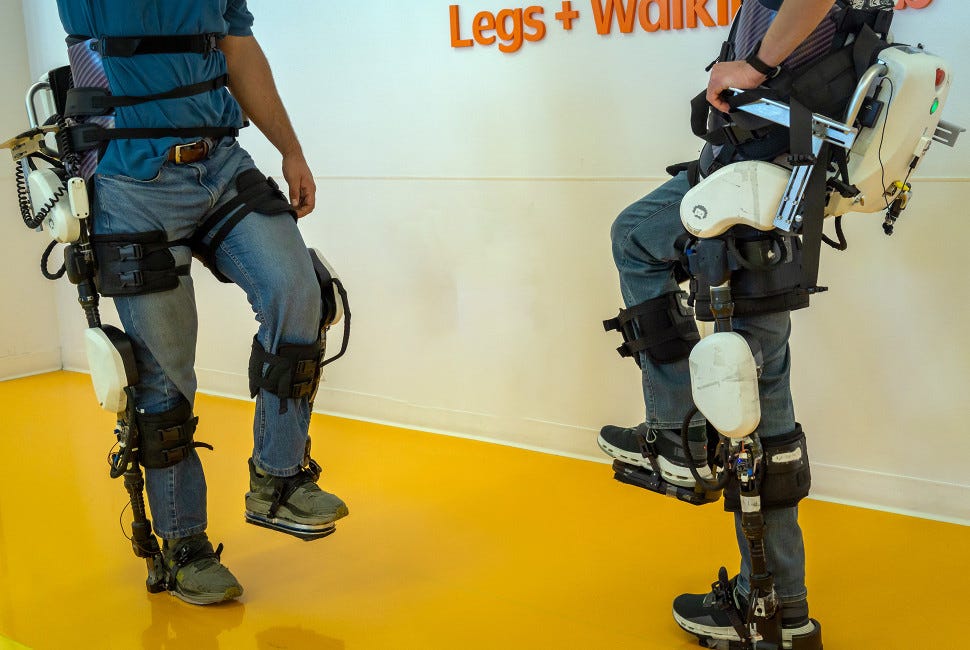
How TEPI Works
The intervention, called therapist-exoskeleton-patient interaction (TEPI), has both a therapist and a stroke survivor wear a lower-limb exoskeleton virtually connected at the hips and knees. The virtual connection behaves like a combination of springs and shock absorbers, allowing the two to influence each other’s movements in real time.
In conventional therapy, therapists can physically assist only a limited number of movements at once, often focusing on a single aspect of gait. More complex whole-body training can require multiple therapists. Existing rehabilitation exoskeletons, meanwhile, often rely on fixed movement patterns that do not fully adapt to a patient’s performance.
“By combining the hands-on adaptability of physical therapy with the scalability and precision of robotic systems, it can enable more comprehensive, whole-body gait training without requiring multiple therapists,” said Lorenzo Vianello, a postdoctoral researcher at Shirley Ryan AbilityLab and co-first author of the paper.
Results and What’s Next
In evaluations with eight stroke survivors, TEPI outperformed conventional therapist-guided treadmill training on several measures. Participants demonstrated greater joint range of motion, took longer and higher steps, maintained similar muscle activation, and reported high levels of motivation and enjoyment.
“Therapist-led rehabilitation remains the foundation of recovery for many patients, and this research shows promise for complementing this standard of care,” said José L. Pons, who led the research program. Pons is a scientific chair at Shirley Ryan AbilityLab and professor at Northwestern University Feinberg School of Medicine.
Nearly 800,000 Americans survive a stroke each year, according to the Centers for Disease Control and Prevention, and many face months of intensive rehabilitation to regain the ability to walk. The researchers plan next to explore applying the framework to overground walking, stair climbing and sit-to-stand transitions, as well as more accessible systems that could extend therapist-guided rehabilitation into patients’ homes.
Additional Resources for Inquisitive Minds:
New exoskeleton therapy could redefine how stroke survivors relearn to walk. Northwestern Now. June 17, 2026.
Read the study:
Therapist-exoskeleton-patient interaction for gait therapy Science Robotics. June 17, 2026.
Editor’s Note: The podcast attached to this article was created using Google’s NotebookLM technology and the resources in this article. Ironically, despite all the technology, the AI hosts still can’t pronounce “droids.”
#robotics


