
Solving the mystery of why our car had a bad day: "Mad Max Mode."

An unexpected lane change? It wasn’t FSD acting up. It was Mad Max mode.
When our Tesla suddenly darted toward the shoulder, then started making aggressive lane changes without any navigation input, we were puzzled — and a little rattled.
Was FSD bugging out?
Turns out, it wasn’t a glitch. It was a setting.
Specifically: Mad Max mode.
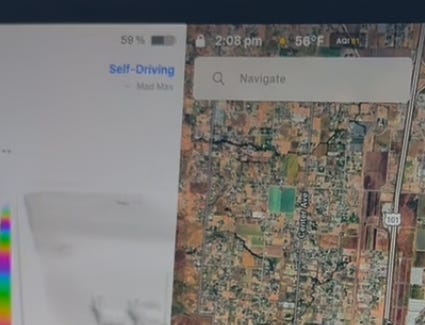
🚗 What Is Mad Max Mode?
Mad Max Mode is one of Tesla’s selectable driving profiles within Full Self-Driving (Supervised). Reintroduced in version 14.2.1, it’s the most aggressive option available, and it absolutely lives up to the name.
Tesla’s current behavior profiles span a five-level spectrum:
Sloth (most conservative)
Chill
Standard
Hurry
Mad Max (most aggressive)
Mad Max is inspired by the high-octane chaos of the Mad Max movie franchise — and it shows. Key characteristics include:
Aggressive Acceleration: It launches from stops quickly and prioritizes higher cruising speeds.
Assertive Lane Changes: FSD takes tighter gaps, passes slower vehicles frequently, and prefers the fast lane.
Speeding Tendencies: It often exceeds posted speed limits to maintain flow with faster traffic or shave off time.
Visual Cue: In this mode, the on-screen FSD car leaves a rainbow trail — Tesla’s own nod to its flamboyant behavior.
This isn’t your grandma’s Autopilot. This is your cousin with a need for speed.
❗ Why This Explained Everything
We’d assumed we were in Chill mode.
After all, that’s what our driving profile was set to. But we didn’t realize the FSD behavior profile had defaulted to Mad Max — likely from an earlier setting or post-update quirk.
So when the car:
abruptly darted for the shoulder,
initiated unsignaled lane changes,
accelerated to 69 mph in a 50 mph zone,
…it wasn’t misbehaving. It was doing what Mad Max is supposed to do.
Fast gaps. Hard moves. No apologies.
🧠 Autonomy Has a Personality Now
This brings up something deeper:
Tesla isn’t just building smart systems. It’s building systems with personality profiles.
That’s both fascinating and concerning:
Trust: Can drivers trust FSD if they don’t know which “mode” it’s operating in?
Predictability: Can other road users or regulators understand the vehicle’s likely behavior?
UX Transparency: How many Tesla owners even know Mad Max exists?
Tesla lets you toggle these behavior modes in the Autopilot settings — but there’s no clear onboarding or explanation. You could be in Mad Max and not realize it until the car blasts past your comfort zone.
⚖️ A Growing Regulatory Flashpoint
It’s not just drivers who are asking questions.
The NHTSA has opened investigations into crashes and near-misses involving FSD in Mad Max mode.
Critics argue that it blurs the line between driver-assist and autonomy.
Tesla maintains that drivers are still responsible, but the behavioral automation feels more autonomous than ever.
Mad Max increases risk by tightening the margins — smaller gaps, higher speeds, more confident maneuvers. Great for highways. Risky for town driving.
Especially when a bird drops a bullseye on your forward camera.
⚡ TL;DR: What to Know About Mad Max Mode
It’s Tesla’s most aggressive FSD setting — beyond Chill, Standard, and Hurry.
It’s designed for speed and assertiveness, favoring quick merges and higher speeds.
It’s visually distinct, showing a rainbow trail on the display.
It’s polarizing — loved by some, feared by others.
It can trigger unexpected behaviors if enabled without realizing it.
🎬 Final Thought: Not a Bug, a Character
Tesla FSD isn’t misbehaving.
Sometimes, it’s just in Mad Max character.
So if your car feels like it’s channeling a Fast & Furious stunt driver, maybe check your settings before blaming the AI.
Autonomy isn’t just intelligence. It’s style.
And Mad Max has a lot of it — whether you’re ready or not.
#TeslaFSD #MadMaxMode #FSD1421 #FullSelfDriving #TeslaUpdate #HW4 #AutonomousVehicles #AggroAutonomy #AVSafety #TrustInAI #AutonomyUX #NHTSA #DROIDsNewsletter #DriveCarefully
I was just re-reading this post, and I was thinking about "Sloth" mode. So, this mode is new to the FSD v14 update. It offers the most conservative driving profile with lower speeds, larger following distances, and less frequent lane changes than "Chill" mode. It is ideal for those seeking a very cautious driving experience.
This mode might be a good starting point for folks like my husband who find FSD to be nerve-wracking. And, as I mentioned in the video, he is not alone. Since 98 percent of folks don't convert from a free trial to a paid FSD user, the technology is not currently winning folks over. Now, I'm sure part of that is folks are also doing the cost calculation and deciding: "This is just not worth $100 a month to me."
So, while FSD is definitely improving, until the price comes down, folks are not likely to sign up after the free trial. I was reading a chat in r/TeslaLounge and some owners were saying they'd be willing to pay $50/month max.
My price point? I was thinking $20, based on what I pay for ChatGPT, Gemini, Claude, and cable streaming services. Basically, I get ALL of those for what Tesla wants to charge me for a single month. It's a software program. The revenue stream is calculated in the number of folks they get to sign up for it. Drop the price way down and get a much larger pool of people to opt in. Become the Netflix of car services.