

A damaged C-17 recently returned to the air with a RoboFormed structural repair part. Machina Labs made it directly from a digital design, using robots instead of dedicated tooling.
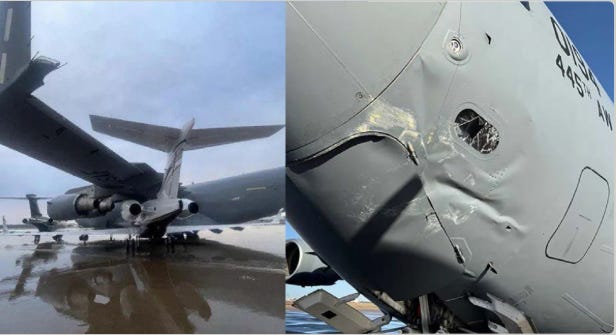
“Qualifying a part from a new manufacturing process for flight can take years, time these critical programs don’t have time to spare,” Mehr said in the company’s August 18 announcement.
A conventional factory usually begins with a decision: What will this factory make?
That choice determines nearly everything that follows, from the machinery and tooling to the layout of the building. Once the investment is made, the factory becomes very good at producing the same thing, over and over.
Mehr wants to loosen that connection between the factory and the product.
“Our goal is to create a platform that can make car parts in the morning,” he told me. “But then in the afternoon, without any major physical change in the platform, it can start doing aircraft. And at night, autonomously, it can do missile components.”
Machina calls its system RoboCraftsman. It is a general-purpose manufacturing platform designed to perform different jobs through software rather than through a physical rebuild of the factory.
The company became known for RoboForming, its process for turning a flat sheet of metal into a finished shape with two industrial robots working from opposite sides. Watching the process brings to mind a potter molding clay, except the material is metal and the hands belong to robots.
“People don’t realize that metal is very, very plastic,” Mehr said. “It’s very impressionable.”
The robots supply the force and precision needed to shape the material incrementally. By applying compression from both sides, they can manage how the metal stretches and hardens as it takes form.
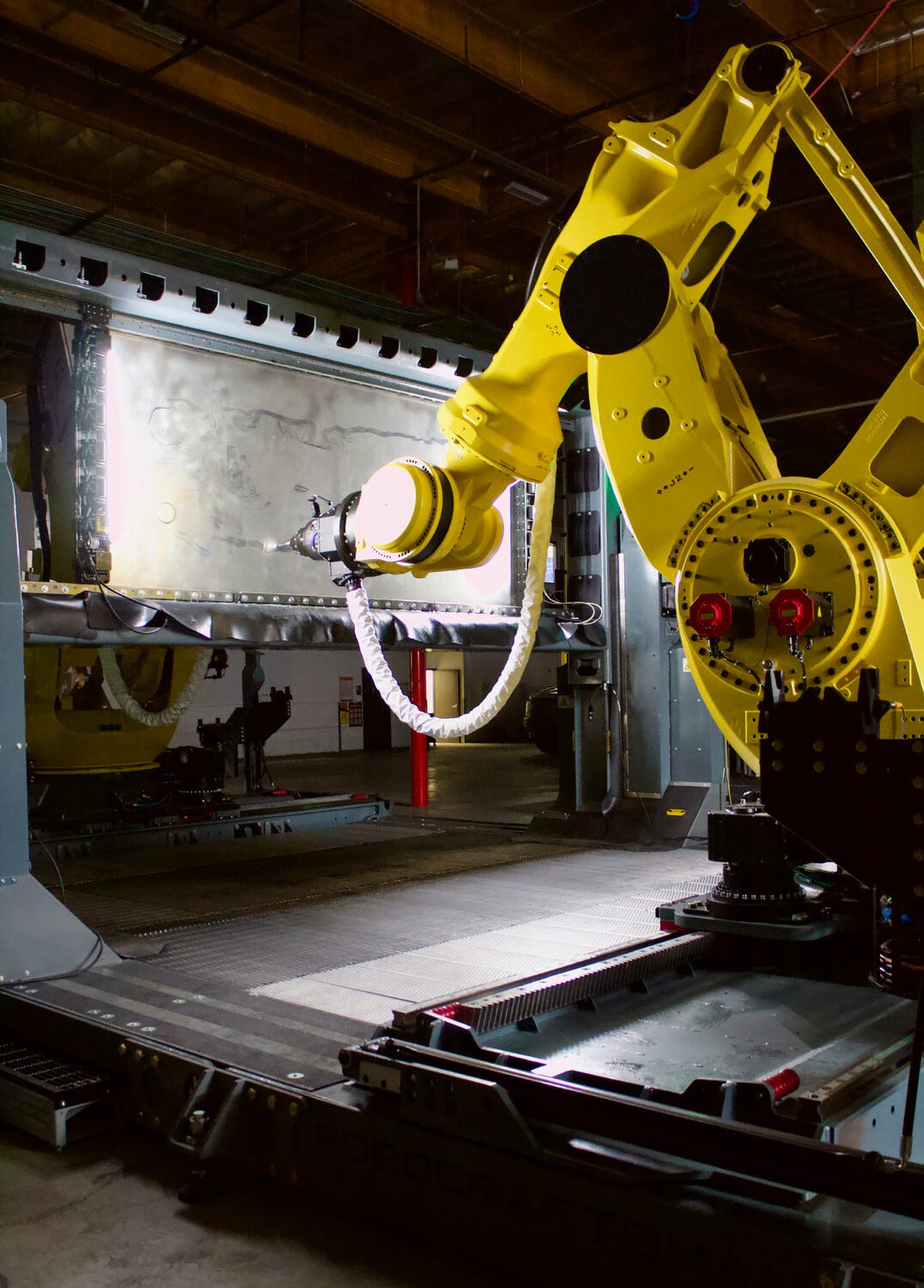
The underlying craft is not new. Metalworkers have shaped material this way for generations. What has changed is who, or what, is holding the tools.
“It’s almost the way craftsmen did it a while back,” Mehr said. “But now robots are doing it.”
A different kind of scale
Traditional manufacturing excels when enormous numbers of identical products are required. Mehr points to Toyota, which can produce a vehicle roughly every 60 seconds in the United States.
“What traditional manufacturing cannot do is make a different car every 60 seconds,” he said.
That is the opening Machina is pursuing.
In its work with Toyota, the company can customize parts that have already moved through the automaker’s conventional production system. A Tacoma hood or tailgate, for example, can be given a design chosen by its owner.
Toyota keeps the efficiency of mass production while adding a level of individual expression that conventional tooling makes difficult or expensive.
Manufacturing has traditionally relied on economies of scale: Invest in specialized equipment, then make enough copies of the same product to recover the cost. Mehr believes programmable factories could make variety economical, too.
The result could be a world in which cars, buildings and other physical products no longer look so much alike.
“That’s actually a limitation of manufacturing,” he said. “We can only scale and make cheap stuff today if we’re making the same thing over and over again.”
Machina describes itself as a physical AI company because its larger goal goes beyond automating an existing production line. Mehr compares the idea to the way a person can express an intent to a large language model and receive text or an image in return.
Here, the output is a physical object.
Lessons from SpaceX
Mehr’s interest in flexible manufacturing grew out of his time at SpaceX.
He remembers arriving at its Hawthorne factory and feeling like “a kid in a candy shop.” Rockets, which he had associated with governments and national space programs, were being built by a company in Southern California.
He also saw how the physical constraints of manufacturing slowed even the fastest hardware companies. Every new product could require a different facility, a new set of tools and another large capital investment.
“My focus has been on bringing this agility back,” he said, “bringing software-like agility to manufacturing.”
Defense has become an early adopter because it presents precisely that problem. The sector needs many different systems, often in relatively small quantities, and must be able to respond quickly when demand changes.
Lockheed Martin’s relationship with Machina spans investment and production. Lockheed Martin Ventures invested in the company in 2023. Three years later, Lockheed Martin awarded Machina a qualification contract in support of the Joint Air-to-Surface Standoff Missile, or JASSM, program.
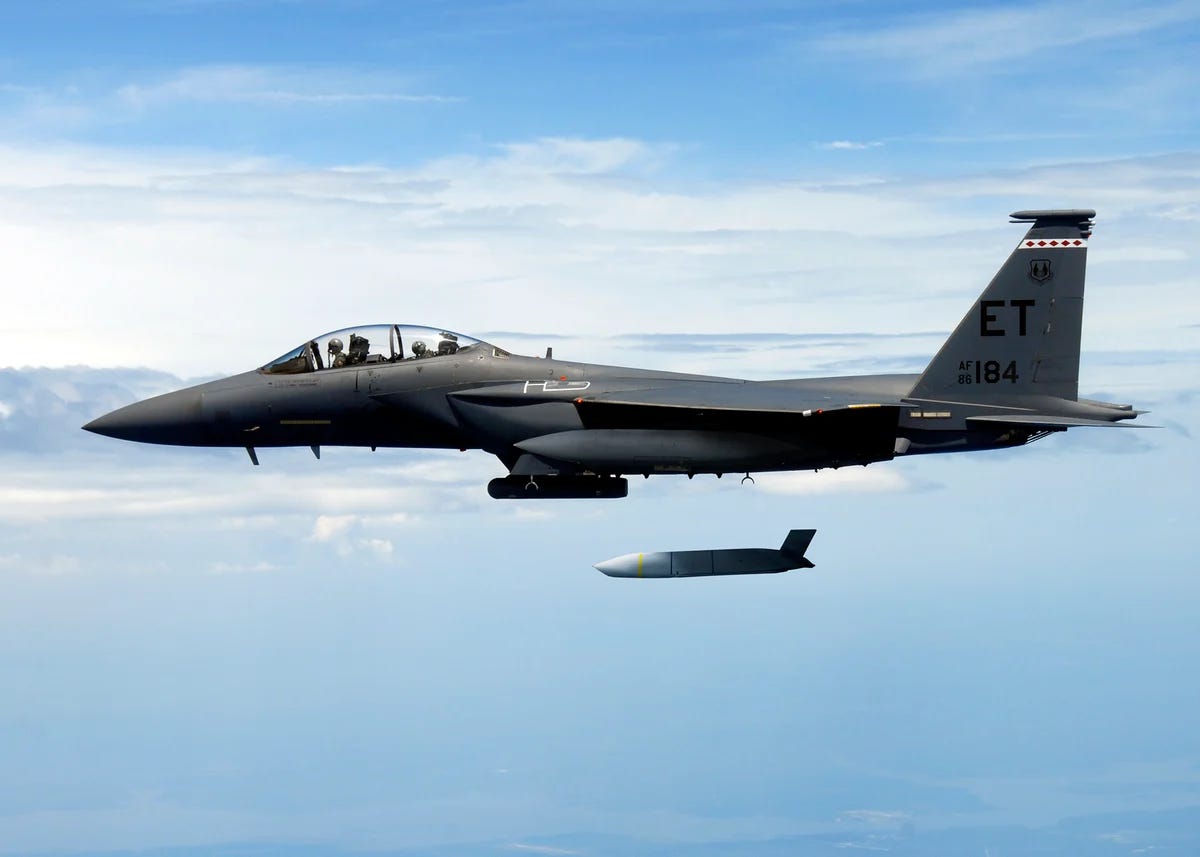
The contract marks the first time an assembly produced in a Machina factory has entered qualification for a defense missile system, according to the company. The assembly combines RoboForming with precision laser welding.
“Missile programs are not constrained by design,” Mehr said when the contract was announced. “They are constrained by production.”
The work will be supported by Machina Factory 3, a 200,000-square-foot defense production facility now under development. Machina says it is being designed to hold as many as 50 RoboCraftsman cells and bring forming, machining, welding and assembly under one roof.
The JASSM qualification program and the C-17 repair approach the same manufacturing problem from different directions. One concerns building new defense systems at a higher rate. The other concerns producing a hard-to-find replacement part to return an existing aircraft to service.
Both depend on the ability to start with a digital design and make a complex metal structure without waiting for dedicated tooling.
The rise of the “teal-collar” worker
A programmable factory changes the work inside it as well.
Mehr uses the term “teal-collar worker” for people whose jobs combine elements of blue-collar and white-collar work. In Machina’s facilities, an employee may operate robots and work with physical parts on the shop floor, then use AI and other software systems at a computer.
“People are going to be both physical and intellectual,” he said. “They’re going to be both blue collar and white collar.”
That combination favors people who can move comfortably between disciplines. Machina still needs deep specialists, but Mehr also sees growing value in employees who can solve physical problems, work with advanced machinery and use AI to learn or execute unfamiliar tasks.
In his view, AI will extend the brain while robotics extends the muscles.
The RoboCraftsman systems are following a similar path. Machina first taught them sheet forming. Mehr expects them to acquire additional trades, including bending, hemming, welding and assembly.
He draws a distinction between this work and efforts to teach humanoid robots basic physical behaviors such as walking, balancing or handling objects.
“We’re teaching our robots to do trades,” he said.
As those skills accumulate, Machina plans to deploy groups of RoboCraftsman systems in programmable factories. Engineers will be able to submit a design through a software portal, receive guidance on making it manufacturable and route the job to the right facility.
One factory might be producing automotive parts while another handles components for the energy sector. Their assignments could change through software as demand shifts.
It is an ambitious vision: a factory defined less by the product it was built to make than by the skills its robots have learned.
And yes, those skills can occasionally be used for something less serious than a missile assembly or aircraft repair.
Visitors to one of Machina’s facilities are greeted by a roughly 14-foot rendering of Han Solo frozen in carbonite, formed in metal.
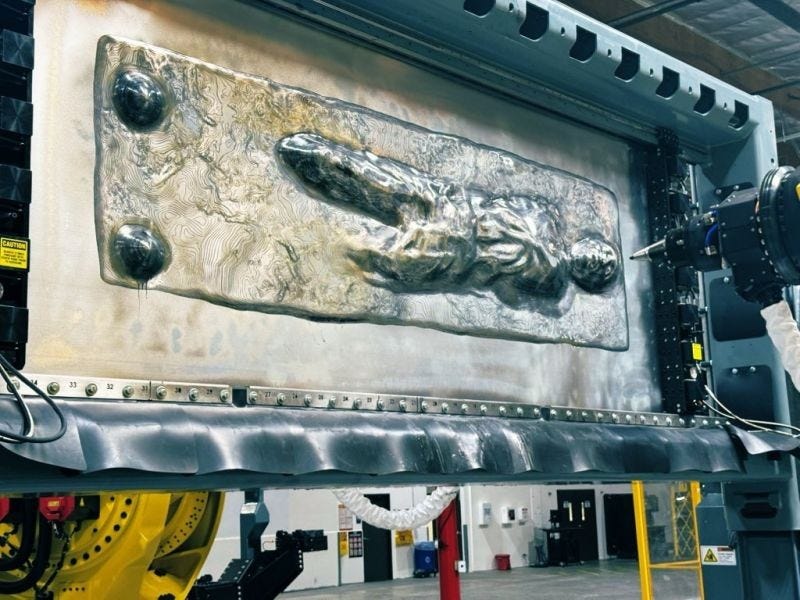
Even the factory of the future, it seems, has room for a little science fiction.
Interested in Jobs at Machina Labs?
When I asked who thrives at Machina Labs, Mehr described “specialists who also have breadth”: people with deep expertise who are curious enough to learn across software, hardware, materials science and manufacturing. His pitch to them is simple: “It’s a rocket ship. Get a ticket if you can.”


