
I Learned About the Long Tail Problem From Jensen Huang and My Car
Why the hardest problem in autonomous driving is everything that almost never happens

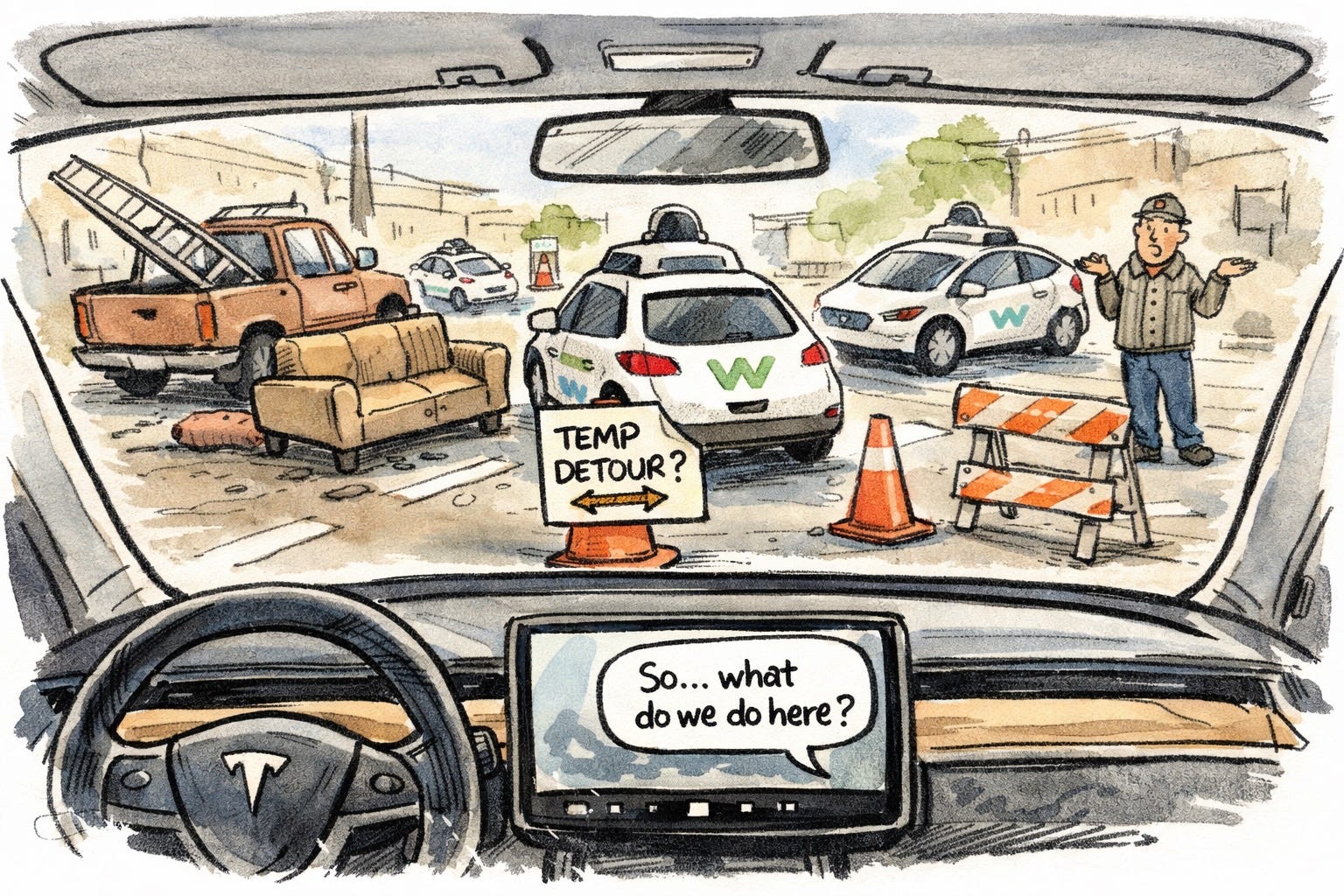
I finally understood the long tail problem in autonomous driving because I was arguing with my car.
Specifically, I was arguing with Grok, which quietly installed itself into my Tesla a few months ago without asking my permission. This felt on brand. Grok has a bit of a bad boy reputation in the language model world, but there it was, sitting behind the steering wheel, free for the time being. So I started talking to it.
Imagine Michael talking to KITT in Knight Rider. Except instead of chasing criminals, I am asking deeply nerdy questions about autonomous driving while sitting in traffic.
“Hey Grok,” I said. “Jensen Huang mentioned the long tail problem in autonomous driving in his keynote. What is that?”
Grok launched into a highly technical explanation and wrapped it up with a cheerful, “You follow?”
I did not.
“Explain it to me like I’m five,” I said.
Grok tried again, this time using chocolate and pickles as metaphors. It ended with, “Now you getting it?”
Sort of. But at this point I was more entertained than educated. So I escalated.
“Explain it to me like I’m elderly.”
Grok immediately adopted a grandmotherly tone and started telling a story about driving a car, encountering very rare situations on the road, and how those moments cause trouble for autonomous systems. It concluded with, “Now you got it, sonny?”
Yes. I finally did.
And that conversation sent me down a rabbit hole on something that turns out to be one of the hardest problems in self driving.
What the Long Tail Actually Is
The long tail problem is not the same thing as an edge case, even though people often use the terms interchangeably.
An edge case is a rare scenario you can usually define ahead of time. A fallen ladder on the freeway. A pedestrian dressed as a traffic cone. A dog on a skateboard. Weird, but imaginable.
The long tail is everything you did not think to imagine.
It refers to the enormous number of extremely rare, messy, unpredictable situations that happen in the real world. Each one occurs infrequently, but taken together, they are endless. Construction zones that change overnight. Hand signals from a traffic officer you have never seen before. A mattress tumbling out of a truck during a rainstorm at dusk. A driver doing something irrational because humans are, well, human.
Humans handle these moments instinctively because we generalize. We reason. We make judgment calls with incomplete information.
Autonomous systems struggle because they are trained on patterns. The long tail is where patterns break down.
Why This Is So Hard for Self Driving Cars
Most autonomous driving systems perform extremely well in the middle of the distribution. Clear lanes, standard signage, predictable behavior. This is the part of driving that happens most of the time.
The long tail lives at the edges of reality. These scenarios are rare, hard to simulate, and difficult to capture in training data. You cannot simply collect enough examples of every strange thing that might happen on the road, because the list never ends.
This is why autonomy progress often feels nonlinear. Cars get very good very fast, and then they seem to stall. What remains is not the easy stuff. What remains is the long tail.
Two Philosophies for Tackling the Long Tail
This is where the approaches of NVIDIA and Tesla start to diverge in interesting ways.
Tesla’s strategy leans heavily on massive real world data collection. Millions of cars, billions of miles, constant feedback from human drivers. The idea is that if you see enough of the world, the long tail becomes less mysterious over time.
NVIDIA’s approach focuses more on simulation and generalizable intelligence. Instead of trying to capture every rare event directly, the goal is to train systems that can reason through unfamiliar situations using rich simulated environments and foundation models. This is where Jensen Huang keeps emphasizing the long tail, because solving it requires more than just scale. It requires adaptability.
Neither approach is obviously wrong. Both are betting on different paths to the same destination.
Why Jensen Keeps Bringing This Up
When Jensen Huang talks about the long tail, he is pointing to the final boss of autonomy.
Highway driving is mostly solved. City driving is improving rapidly. What remains are the moments that make humans tense up behind the wheel. The moments where there is no rulebook and no clean answer.
Until autonomous systems can reliably handle those moments, full autonomy remains just out of reach.
Why I Will Never Forget This Now
Thanks to my car explaining this to me in a granny voice, I now have a mental model I will not shake.
The long tail is not one problem. It is an infinite collection of tiny problems that only appear when reality gets weird.
And reality gets weird a lot.
If autonomous driving ever truly works everywhere, it will be because someone figured out how to teach machines not just how to drive, but how to cope with the unexpected. That is the real challenge hiding behind the buzzwords.
Also, I should probably stop arguing with my car. But honestly, it is starting to grow on me.
#alpamayo #autonomousdriving #longtailproblem
Editor’s note: I have encountered ladders on the highway more than once, so I tend to think of those as edge cases. They are rare, but familiar. In the video above, YouTuber AICKStudio shows something different: a tire rolling freely across the roadway, which I now understand as a clear example of the long tail problem.
I encountered almost the exact same scenario a few months ago while using Autopilot. At the time, I did not have the language for it. I only knew, instinctively, that this was a situation the system might not be equipped to reason through. A tire had spun off an 18 wheeler and was rolling across multiple lanes of traffic with no predictable path. I tapped out immediately. Every car around me slowed as we collectively waited for the tire to complete its strange solo journey before it finally crossed all lanes and came to rest in the median.
Could Tesla’s AI have handled it? Possibly. But in that moment, before I knew the term “long tail,” I trusted my instincts and chose not to find out.