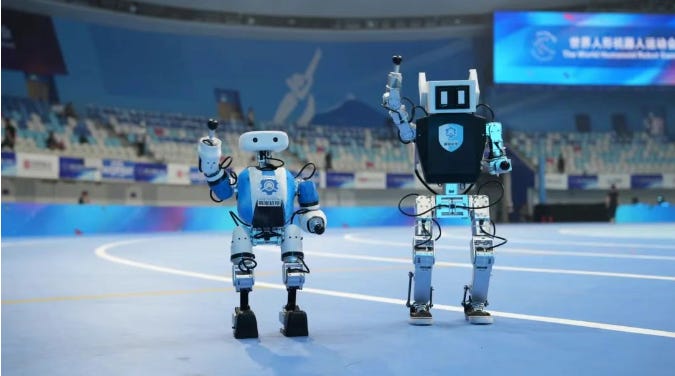
At the crowded entrance of the Humanoids Summit 2025, where dozens of robots teetered, strutted, and ambled through their demos, one pair of bots didn’t just walk — they stomped. Their gait looked almost childlike: little feet planting, pulling forward, momentum charging like they were racing to lunch. It was irresistible to watch.
But it wasn’t only the motion that grabbed attention — it was who made them.
I caught up with the founder of High Torque Robotics, the team behind these surprisingly expressive machines.
From Ads to Androids
What would make someone walk away from a career in advertising to launch a humanoid robotics venture?
For the founder of High Torque Robotics, it wasn’t a calculated pivot. It was curiosity mixed with conviction.
He began in 2020, long before the company was officially formed. In his own words, he had no background in robotics. But watching robotic dogs and wheel‑based platforms emerge in China sparked a question: Why not humanoids? By 2021, he was teaching himself the fundamentals — from mechanics to embedded electronics — by watching every relevant video he could find and experimenting on his own.
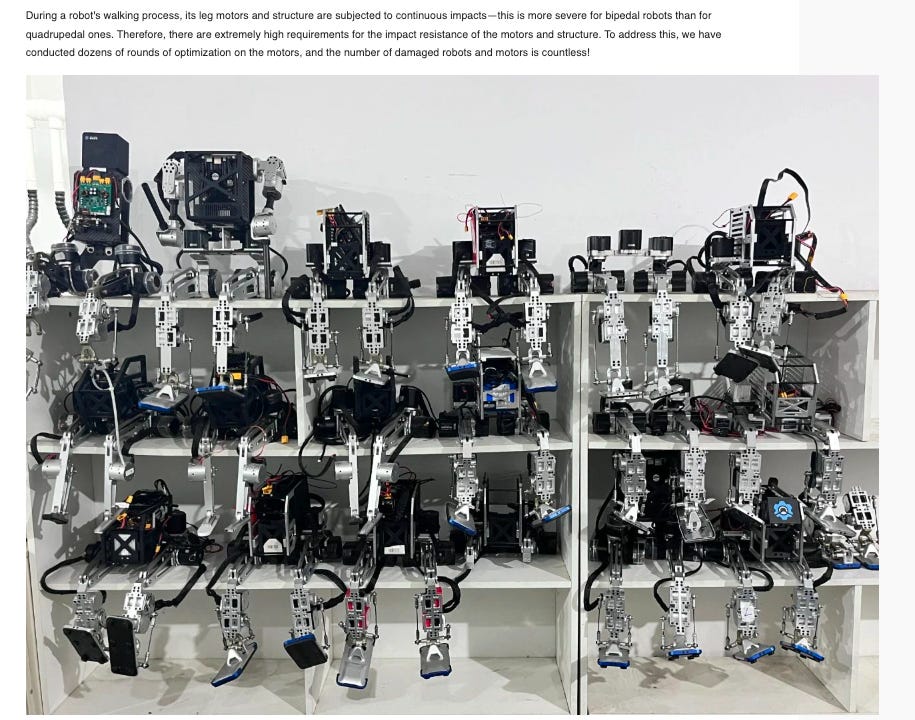
In a small room, with no mentors and no roadmap, he built his first wheel‑legged prototype alongside collaborators. From there, he learned the roles needed: mechanical design, motion control, sensors, software. And when off‑the‑shelf motors weren’t up to the task, he designed his own.
This kind of autodidactic grit is unusual. But at the summit, it paid off in visible ways.
Gait That Feels Alive
At first glance, the robots walking at the booth look charmingly playful — almost like kids sprinting through an airport terminal. But beneath that seemingly whimsical step is hard engineering.
Traditional humanoid motion can feel stiff or rehearsed. But the High Torque bots use reinforcement learning — motion policies trained on human data — to generate gait that feels natural within the constraints of their hardware. This gives them that little bounce, that impulsive push‑off of the foot, that makes them feel familiar even though they’re machines.
And while the current generation isn’t fully autonomous — relying on teleoperation or basic perception — they dosense people and obstacles around them. That perceptual ability lets them navigate crowded show floors without running into chairs or legs.
It’s not storytelling. It’s engineering.
The Path From Prototype to Platform
From the founder’s blog, it’s clear High Torque views the current stage of humanoid robotics like the early days of personal computers:
Hardware is here, but without an ecosystem of developers and tools — without accessible platforms — uptake will be slow. His goal isn’t just to build robots. It’s to build a developer‑friendly platform — a base that others can build on, innovate with, and catalyze the next wave of humanoid applications.
To that end, his team has developed:
Custom reducers and brushless motors
Proprietary torque sensors and test benches
Multiple prototype architectures
A compact design focus for developer efficiency
This is not off‑the‑shelf engineering.
It’s in‑house innovation aimed at lowering the barrier to entry for future humanoid developers.
Two Horizons: Factories and Homes
When I asked about where these robots might first be used, the founder clearly saw two paths:
Industrial Assistance, where robots help humans in controlled environments.
Household Companions, where robots integrate into daily life.
He believes that software — not hardware — will be the key growth driver moving forward. As perception stacks and motion planning mature, these robots could transition from research platforms to real world collaborators.
And judging by the way people stop to watch them stomp down the hallway? There’s no doubt they already capture imagination.
Why This Matters
Humanoid robotics is no longer about simply making robots balance. It’s about giving them presence — a sense of movement that resonates with us, that feels alive in a way rigid locomotion never did. High Torque’s robots aren’t the most polished at this year’s summit. But their motion has personality. And that’s meaningful.
We remember movement before we remember specs.
They’re involved in research with top universities and they’re all also involved in robot soccer. This video is entertaining, as are all videos of robot soccer, but also shows the robustness of this particular bipedal platform.
My fellow influencer, Jonathan Stephens, did a great interview at the Humanoid Summit with another member of the High Torque Robotics team. You can check out that interview here.
Learn more about High Torque Robotics.